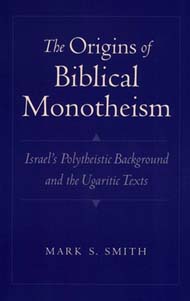
The Origins of Biblical Monotheism
Israel's Polytheistic Background and the Ugaritic Texts
Mark S. Smith
325 Pages, ISBN 978 0 19 516768 9
Published by Oxford University Press, 2001
"Brilliant, well-documented, well-organized, and very discomforting. Biblical scholars now
recognize that in the pre-exilic era Asherah worship, infant sacrifice, solar veneration, and
other religious practices attacked by biblical authors represented normal Israelite worship,
while monotheism was a late development in the Babylonian Exile and subsequent years.
Smith and others led the charge in this new scholarly perception of Israelite religion. But with
this volume Smith has thrown down a gauntlet to challenge our understandings even more.
Smith has produced a seminal work with which scholars must come to grips for years."
- Journal of Hebrew Scriptures
As the Bible tells us, ancient Israel's neighbors worshipped a wide variety of gods. It is
now widely accepted that the Israelites' God, Yahweh, must have originated as one among
these many, before assuming the role of the one true God of monotheism. In recent years,
many scholars have sought a better understanding of this early polytheistic milieu and its
relation to the God of Isreal.
Here, Mark S. Smith seeks to discover more precisely what was meant by "divinity" in the
ancient near-East, and explores how these concepts apply to Yahweh. Part One of the book
offers a detailed examination of the deities of ancient Ugarit, known to us from the largest
surviving groep of relevant extra-biblical texts. Smith examines the Ugaritic idea of a
divine "family" and notes the correspondence between the four tiers of the Ugaritic
pantheon and the four levels of a family household in Ugaritic society. In the society, he
contends, the polytheism of a divine family would have been far more intelligible than any
notion of monotheism. In Part Two, Smith explores four classic problems associated with
Ugaritic deities, considering how they affect our understanding of Yahweh. In conclusion,
he returns to the question of Israelite monotheism, seeking to discover what religious issues
it addressed, and why it made sense at the time of its emergence. True monotheism
emerged only in the latter half of Isreal's history, concludes Smith, and was heir and reaction
to a long tradition of Israelite polytheism.
Mark S. Smith is Skirball Professor of Bible and Ancient Near Eastern Studies at New York
University. His publications include The Pilgrimage Pattern in Exodus (1997),
The Ugaritic Baal Cycle (1994), The Early History of God (1990), as well as
several other books on the Hebrew Bible, the Dead Sea Scrolls, and West Semitic mythology and literature.
(The text above comes from the back of the book)